Showing posts with label software security. Show all posts

1/12/2013

SpyderSoft - Wi-Fi Defense Review

SpyderSoft - Wi-Fi Defense
Average Reviews:

(More customer reviews)
If you want an awesome piece of software to protect your home/small business against wireless intruders this would be it. The software has this very easy to use interface that actually can interface with your wireless router. I don't know how it does it but it is very cool. I have a Dell router and installed the software and it knew I had a Dell router. It prompted me for by admin account and password and presto I have easy security on my network. It shows you in this easy to use inteface who is connnected and allows me to keep them or restrict them. This is a must have security software!!!!

Click Here to see more reviews about: SpyderSoft - Wi-Fi Defense


Buy Now

Click here for more information about SpyderSoft - Wi-Fi Defense

Read More...

5/04/2012

SOA Security Review

SOA Security
Average Reviews:

(More customer reviews)
Great book for starters.
However it misses the latest Standards in Security such as PKI, SAML, XACML, WS-Federation, WS-Trust and how it pertains to SOA based solution architecture. So much for a book titled "SOA Security". Also it totally ignores to explain how to ensure security at all integration tiers.
Not for security experts, more for people who are starters and do not have time to "Google" either.
Does not do detailed coverage only basic topics related to Web services security around SOAP and WSDL standards with Apache Axis sample APIs (which are out of box and can be googled easily) are discussed. It is a bit difficult to relate the examples to the meat on the book.
Also missing is the information on how to use the abused Apache API examples to compose/build a Secure SOA service base architecture or how to secure BPM workflows, SOA governance, Identity management using federation, entitlement issues with BPM portals,... the list goes on.
This book contains very repetitive content. The only good portion I found was the chapter on XML Web services. The authors should refer Information Security Management Handbook, Sixth Edition (Isc2 Press) and Core Security Patterns: Best Practices and Strategies for J2EE(TM), Web Services, and Identity Management (Sun Core Series) before the next version comes out.

Click Here to see more reviews about: SOA Security


SOA is one of the latest technologies enterprises are using to tame their software costs - in development, deployment, and management. SOA makes integration easy, helping enterprises not only better utilize their existing investments in applications and infrastructure, but also open up new business opportunities. However, one of the big stumbling blocks in executing SOA is security. This book addresses Security in SOA with detailed examples illustrating the theory, industry standards and best practices.

It is true that security is important in any system. SOA brings in additional security concerns as well rising out of the very openness that makes it attractive. If we apply security principles blindly, we shut ourselves of the benefits of SOA. Therefore, we need to understand which security models and techniques are right for SOA. This book provides such an understanding.

Usually, security is seen as an esoteric topic that is better left to experts. While it is true that security requires expert attention, everybody, including software developers, designers, architects, IT administrators and managers need to do tasks that require very good understanding of security topics. Fortunately, traditional security techniques have been around long enough for people to understand and apply them in practice. This, however, is not the case with SOA Security.

Anyone seeking to implement SOA Security is today forced to dig through a maze of inter-dependent specifications and API docs that assume a lot of prior experience on the part of readers. Getting started on a project is hence proving to be a huge challenge to practitioners. This book seeks to change that. It provides bottom-up understanding of security techniques appropriate for use in SOA without assuming any prior familiarity with security topics on the part of the reader.

Unlike most other books about SOA that merely describe the standards, this book helps you get started immediately by walking you through sample code that illustrates how real life problems can be solved using the techniques and best practices described in standards. Whereas standards discuss all possible variations of each security technique, this book focusses on the 20% of variations that are used 80% of the time. This keeps the material covered in the book simple as well as self-sufficient for all readers except the most advanced.


Buy NowGet 36% OFF

Click here for more information about SOA Security

Read More...

4/28/2012

Role-Based Access Control, Second Edition Review

Role-Based Access Control, Second Edition
Average Reviews:

(More customer reviews)
The three authors are leaders in RBAC research and development, making this book one of the most authoritative and complete references to RBAC.
Chapters 1 through 3 give a solid foundation for understanding RBAC and how it evolved, starting with an introduction, an exhaustive survey of access control methods needed to fully understand the evolution, and a solid and detailed overview of RBAC itself.
In the subsequent chapters each aspect of RBAC is covered in depth. Topics include role hierarchies, separation of duty policies, administration, integrating RBAC into existing infrastructures, and migration to RBAC. In addition, there are chapters on related topics that give this book wide scope - "Using RBAC to Implement Military Policies" shows how to implement multi-level security models with RBAC. This information uses military policies, but the material is also of interest to any commercial organization seeking tightly integrated access controls and a high security posture. The chapter on the proposed NIST RBAC standard also covers key items of interest, including Common Criteria RBAC protection profiles and other conformance issues. There are also chapters on RBAC research and prototypes, and commercial products.
While this book is well written and uses illustrations to impart key concepts, you will need to be conversant with set theory in order to get the most from it, as well as understand RBAC itself. If you are a bit rusty I recommend refreshing your skills before diving into this book.
If you want to explore RBAC and the work of each of the authors visit NIST Computer Security Division and Computer Security Research by pasting the ASIN, B0001O48Y4, into the search box, selecting all products and clicking GO. Once you are on the site you'll find the RBAC section under Security Research/Emerging Technologies->Authorization Management and Advanced Access Control Models (AM&AACM) link.

Click Here to see more reviews about: Role-Based Access Control, Second Edition

Role-based access control (RBAC) is a security mechanism that has gained wide acceptance in the field because it can greatly lower the cost and complexity of securing large networked and Web-based systems. Written by leading experts, this newly revised edition of the Artech House bestseller, Role-Based Access Control, offers practitioners the very latest details on this popular network security model. The second edition provides more comprehensive and updated coverage of access control models, new RBAC standards, new case studies and discussions on role engineering and the design of role-based systems. This authoritative book offers professionals an in-depth understanding of role hierarchies and role engineering that are so crucial to ensuring total access control with RBAC. The book guides security administrators through the various RBAC products available on the market and along the migration path to implementing RBAC. This unique resource also covers the RBAC standard proposed by the National Institute of Standards and Technology.

Buy Now

Click here for more information about Role-Based Access Control, Second Edition

Read More...

3/06/2012

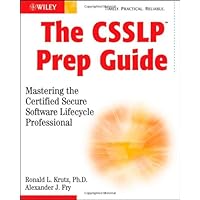
The CSSLP Prep Guide: Mastering the Certified Secure Software Lifecycle Professional Review

The CSSLP Prep Guide: Mastering the Certified Secure Software Lifecycle Professional
Average Reviews:

(More customer reviews)
THe CSSLP Prep Guide is an excellent source for understanding the fundamentals and basics of Secure Software Development, however after sitting for the CSSLP exam the book misses the mark and is not very well suited for preparing to take the exam.
The exam is filled with subjectivity as you really have to understand the mindset of the person writing the question as the answers are what is BEST or PRIMARY or MOST IMPORTANT OR MUST BE DONE and the book can't really prepare you for that.
It will still be used as an excellent piece of reference material for buidling the overall security program within my organization but if I didn't pass the exam I will wait for the ISC(2) book or take a boot camp class to prepare for the re-take.

Click Here to see more reviews about: The CSSLP Prep Guide: Mastering the Certified Secure Software Lifecycle Professional


The first test prep guide for the new ISC2 Certified Secure Software Lifecycle Professional exam

The CSSLP (Certified Secure Software Lifecycle Professional) is a new certification that incorporates government standards and best practices for secure software development. It emphasizes the application of secure software methodologies during the software development cycle. If you're an IT professional, security professional, software developer, project manager, software assurance tester, executive manager or employee of a government agency in a related field, your career may benefit from this certification.
Written by experts in computer systems and security, The CSSLP Prep Guide thoroughly covers all aspects of the CSSLP certification exam, with hundreds of sample test questions and answers available on the accompanying CD.
The Certified Secure Software Lifecycle Professional (CSSLP) is an international certification incorporating new government, commercial, and university derived secure software development methods; it is a natural complement to the CISSP credential
The study guide covers the seven domains of the CSSLP Common Body of Knowledge (CBK), namely Secure Software Concepts, Secure Software Requirements, Secure Software Design, and Secure Software Implementation/Coding and Testing,Secure Software Testing, Software Acceptance, and Software Deployment, Operations, Maintenance and Disposal
Provides in-depth exploration and explanation of the seven CSSLP domains
Includes a CD with hundreds of practice exam questions and answers

The CSSLP Prep Guide prepares you for the certification exam and career advancement.

Buy NowGet 16% OFF

Click here for more information about The CSSLP Prep Guide: Mastering the Certified Secure Software Lifecycle Professional

Read More...

2/24/2012

Writing Secure Code, Second Edition Review

Writing Secure Code, Second Edition
Average Reviews:

(More customer reviews)
The title of the book is misleading to begin with. The book is not about writing secure code. It's about (1) not writing non-secure code and (2) using Windows specific security APIs.
(1) Not writing non-secure code. Covers several issues, some more obvious, like buffer overruns and validating user input, some more complex, like escaping URLs and socket security. I thought the book would teach me best practices about organizing code, as in "do like I do". Instead it goes like "don't do like I'm telling you".
(2) Using Windows security APIs. This is THE BEST part of the book. Gives you a very good overview about several different APIs, including ACLs, protecting sensitive data, securing DCOM and .NET code, excellent tips on installing programs etc. etc.
Keep in mind that this book is said to be used internally within Microsoft with "security pushes", with the audience of 8000 people, including not only developers of all levels, but managers as well, therefore the book is by definition a high level overview.
Sometimes the book feels like MS educational course. Ex. (tip on p.77) "I created the ... diagrams ... using ... Microsoft Visio Professional 2002". That's cool, but what does it have to do with security ?
Some topics should never be there. How about 3 pages of tips for a kernel driver writer ? It's a huge topic in itself and how many readers outside MS do this anyway ? Privacy issues are covered idealistically. Yeah, sure, if you put a specially crafted XML to the special place on your site, the users magically start trusting you... I'd better read about real situation with privacy, not how the government rules it to be. Oh, and how about 40 pages about cryptography ? Please...
The book tries to show you the security process with development and testing. I can easily see they use this process in Microsoft, with 8000 people. For a small team it's completely useless. How about using 4 (!) people for a code review ? Sure, upon reading this book you will know that security code review is a must (if you have enough resources). Didn't you know that before ?
The code samples are ugly. How about this: "... X is cool ... several pages of Perl (!) ... see what I mean ?". Ok, one of the authors admits to be a Perl fan, but how am I supposed to read through all this gibberish ? C(++) samples are not much better. May be they are fully functional and compilable and all, but please, they are huge and inconsistent in themselves.
All in all, 5 stars for Microsoft, 3 stars for the rest of the world.

Click Here to see more reviews about: Writing Secure Code, Second Edition


Buy NowGet 43% OFF

Click here for more information about Writing Secure Code, Second Edition

Read More...